On Thursday 25 August, fourteen of us joined Martin Catt to enjoy a gentle ramble at North Leigh Common, identifying various plants and learning a little about their traditional uses and folklore.
Initially, Martin talked about how the Enclosures Act had separated good land for cultivation from land of less value, such as North Leigh Common.
The area is a mix of both clay (hence Claypits Lane) and acidic ‘furze’ land where gorse grew (‘Gorselands’). Gorse was, apparently, used for thatching and heating bread ovens. The different plants that grow around the common illustrate the mixed pockets of acid and alkaline soil, hence you get bracken, mugwort and ash trees growing together, each of which thrive on different soils. Mugwort, we were told, is used in brewing, and adds an earthy bitterness to ale.
Martin also pointed out Black Horehound, which, in traditional herbalism, was given to relieve nausea during pregnancy and may, if given in large amounts, have led to miscarriage.
Very few fungi were noted due to the drought, and only small amounts of bracket fungi were seen on a black poplar log. Black spot fungus was abundant on sycamore leaves which, we learned, is a sign that the air is relatively clean. Interestingly, trees growing near to industrial centres with high sulphur emissions tend not to show signs of the fungi.
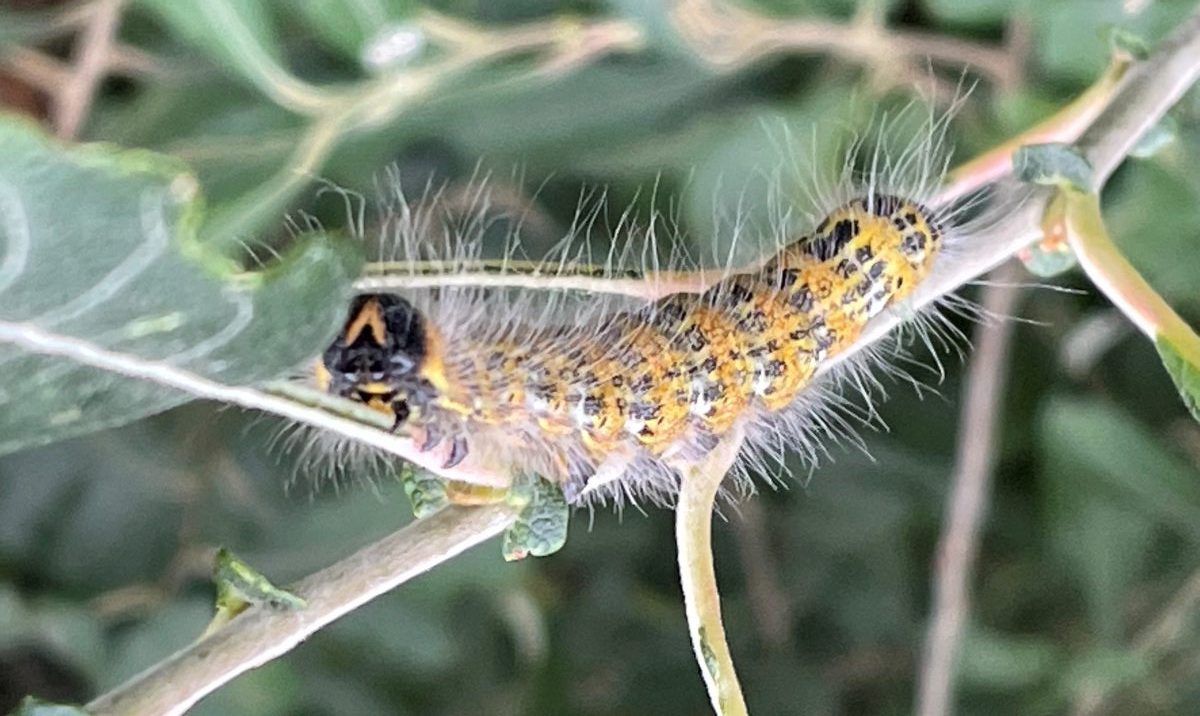
Virtually no insects were observed and no butterflies, probably due to cool and cloudy conditions. Several caterpillars, including that of a bufftip moth, were seen feeding on sallow.
We also observed various examples of leaf miner populations on briars and willow.
As the area is currently so dry, much of the vegetation looked tired and shrivelled. However, after about an hour, a rather pleasant drizzle started which was at least good for the plants if not for those without waterproofs!
Despite the drought, there were plenty of blackberries but the elderberries were shrivelled and dry; only a very few sloes and no hazel nuts were seen.
After about ninety minutes, our pleasant walk came full circle. Martin was thanked for an informative and intriguing walk.
A species list can be found here.
Julia Reid 29 August 2022
 WEST OXFORDSHIRE FIELD CLUB