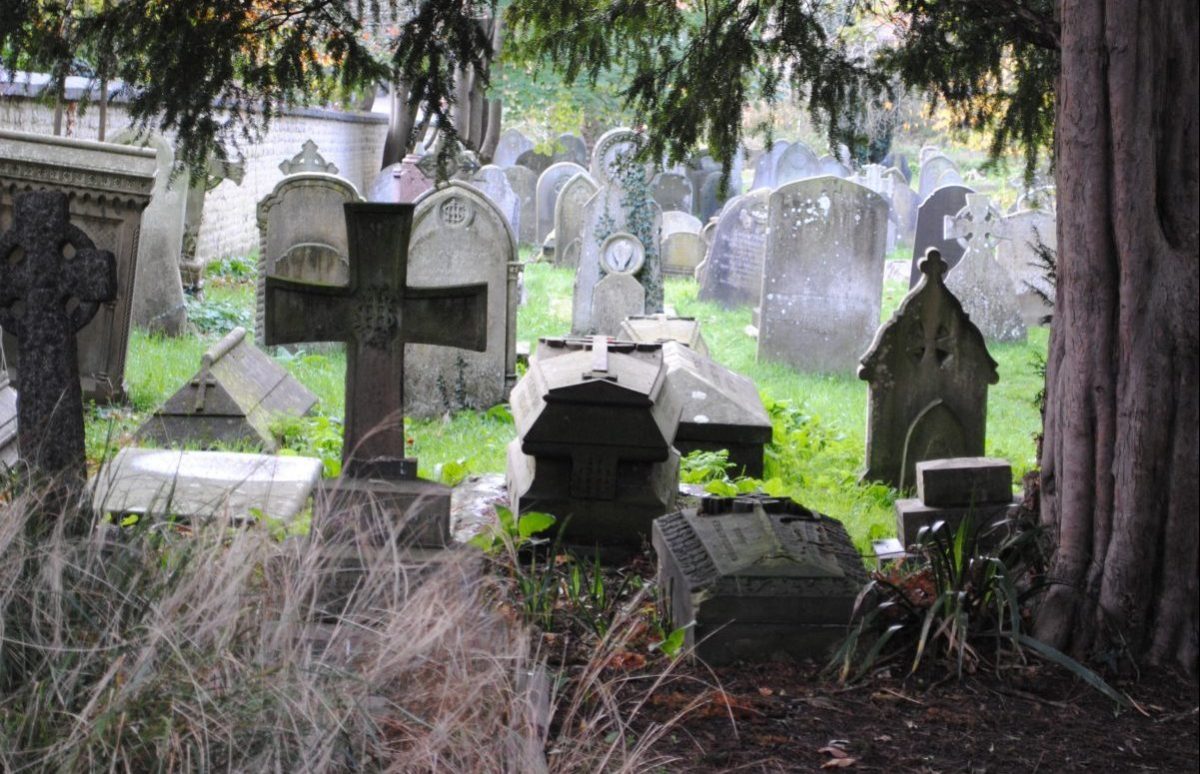
St Sepulchre’s Cemetery, 20 November 2022
A Field Club visit to a long abandoned Victorian graveyard hidden off a back street in Oxford’s Jericho area to study the geology of the gravestones might not seem to have an immediate appeal. However, this visit proved to be fascinating on many different levels for those who came. St Sepulchre’s, we discovered, was a haven of quiet and has become something of a small nature reserve in the heart of the city.
The visit was led by geological specialists Nina Morgan and Philip Powell. They have an infectious enthusiasm for their subject which they were keen to share with us non-experts.
They told us of the underlying importance of geology in understanding the natural world, explaining that the rocks which form our differing landscapes are fundamental to the formation of the different soil types in which plants grow and thus the different habitats for all our wildlife.
The identification of the wide variety of rocks used for gravestones has proved to be one successful way of spreading Nina and Philip’s message. Indeed, they have published a splendid guidebook for St Sepulchre’s and a number of other Oxford cemeteries. The book covers not just details of the rocks used for the actual gravestones but also provides interesting background information on the great and not so good buried beneath them.
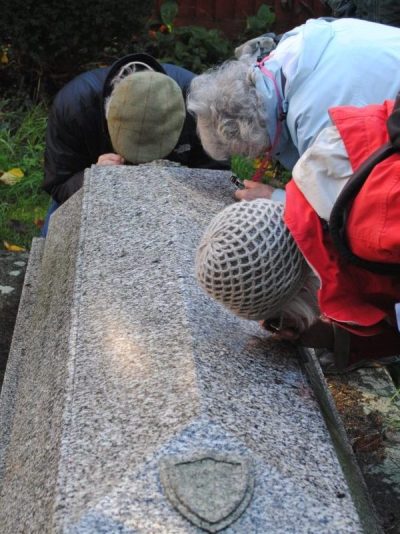
Gravestones are conveniently near one and other and they can be studied safely, in detail and in a comfort not often associated with observation in the field! We were all provided with a hand lens and were encouraged to use them in the time-honoured scientific practice of “look, observe, recognise and record”.
Prior to the coming of the canals and railways in the 19th century, local stone was used more or less exclusively for buildings including headstones, since it was impracticable to move such high volume/low value material around the country. Their arrival enabled the movement of a wide variety of stone from much further afield in this country and Europe. Mechanisation of the tools used to work these stones enabled a flowering of new carving, polishing and engraving techniques to be used.
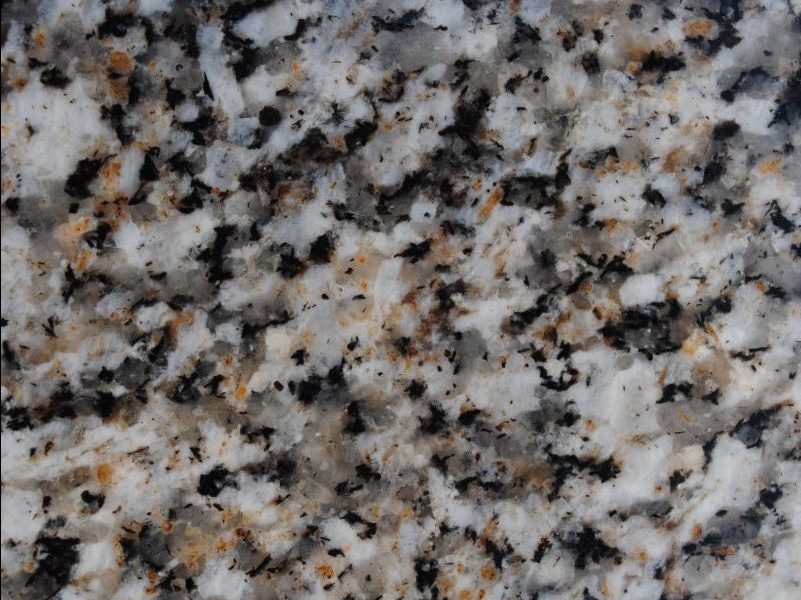
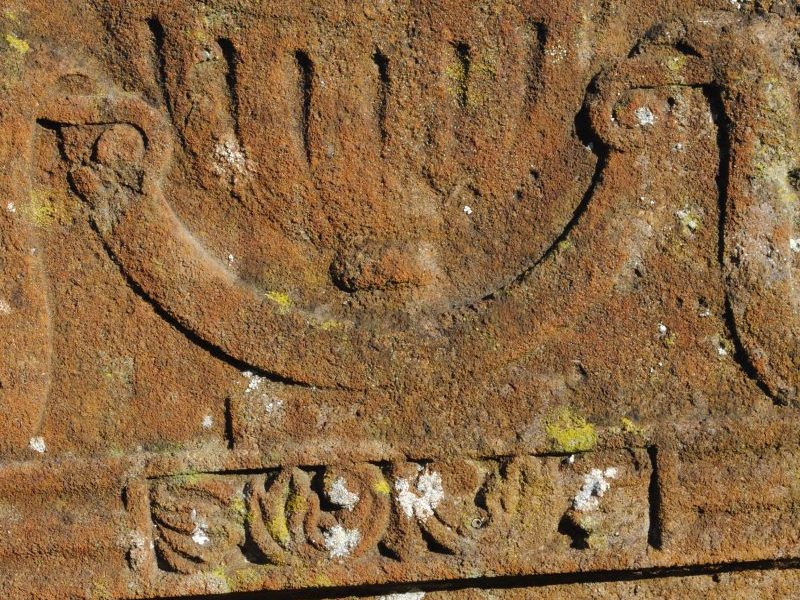
Before examining some headstones, we were reminded of the three main types of rock. Sedimentary, for example sandstones and limestones; Igneous, formed from solidified magma and lava, for example granite and basalt; Metamorphic, which are existing rocks that have been altered by heat or pressure, for example, marble and slate.
The pictures and explanations in the “species list” (!) (here) show but a small part of the astonishing diversity of these rock types that can be found not just in St Sepulchre’s but in literally every cemetery in the country – once you get your eye in.
John Baker, 24 November 2022
Editor’s note: I was not able to do justice here to JB’s photos and technical descriptions of twelve rock types in St Sepulchre’s but a pdf file of them can be downloaded from the Species List page.
 WEST OXFORDSHIRE FIELD CLUB