Sue Leigh writes:
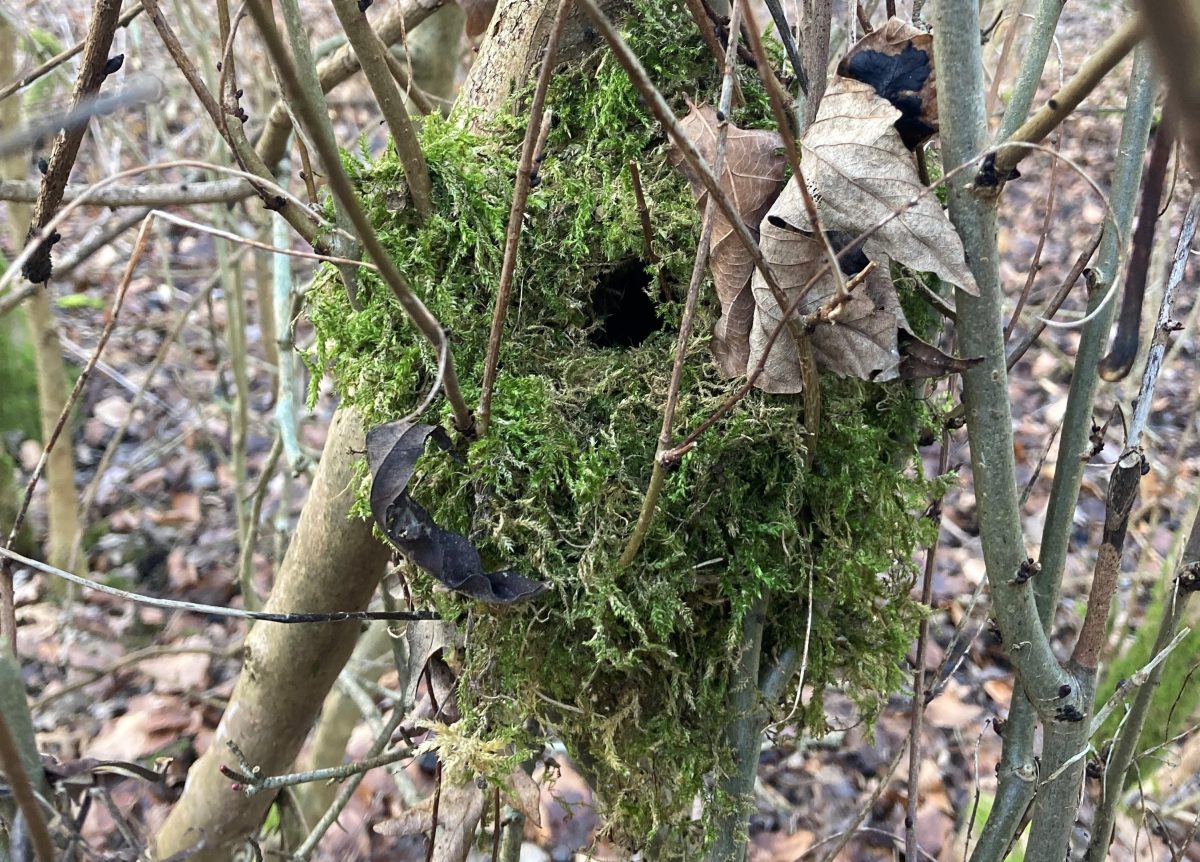
Sherborne woods, early February: The nest I am looking at is round, mainly made of moss with a small entrance hole. It is about four feet from the ground in what looks like a fairly open site but in spring and summer would be under a canopy of leaves and surrounded by more vegetation. It was made by a wren.
What is it about finding a bird’s nest? The poet John Clare reminds us that it recaptures that sense of wonder we had as a child but it also recognizes a kind of vulnerability. (Clare wrote several poems about birds’ nests. I particularly like ‘The Pettichap’s Nest’ in which Clare makes a verbal nest of a poem from fragments of language which stand in for scraps of hay, leaf, feather.)
When I get home I consult Collins Guide to Nests and Eggs. The wren’s nest, it tells me, is domed and often with a tightly woven entrance. It is made of moss, dead grass and leaves (also other local materials). The male bird makes several nests of which only one – lined with feathers by the female – is used for the brood. She will lay five to six white eggs, speckled with brownish red (as if you had pricked your finger while sewing). The nestlings leave the nest after about sixteen days. There are two broods between mid-April and July.
I like the old French proverb ‘Man can do everything but build a bird’s nest’. This returns us I think to that sense of wonder.
Sue Leigh 21 February 2023
Members are encouraged to share their interests, observations and enthusiasms by contributing to this blog. Simply send some text and a photo or two to blog@thefieldclub.org.uk.
 WEST OXFORDSHIRE FIELD CLUB