A walk to hear the dawn chorus has been a fixed event on the Club’s programme for as long as I can remember and, once a year, it’s certainly worth getting up at 3:30am to hear the birds waking up. It’s also a good opportunity to learn birdsong.
Dawn chorus walks used to be well-attended but this year only five of us met at Minster Lovell at 4am on Sunday 7 May. From there we walked slowly to Crawley and back to Minster Lovell on the opposite side of the Windrush. Unusually it was very mild – it can get very very cold at dawn, even in May – and rather damp and misty.
The first bird we heard, at 04:13 was a woodpigeon; a skylark was fourth on the list at 04:25. It was twilight and we watched a bat feeding over the river from the wooden bridge. By 5am we had only got as far as a small wood (very muddy and slippery underfoot!) by the river but the birds were in full voice and we had already ‘ticked’ nineteen or twenty species. In fact, they were in such full voice that it was difficult to pick out individual songs. We expected to see a barn owl when we came out of the woods – there are two owl boxes in the area – but were out of luck this year.
From then on, new species came more slowly. A whitethroat sang from a hedge near Maggots Grove, followed by a blackcap and a chiffchaff. The climb up to Dry Lane was steep and slippery. At the bottom of the track on the other side, Alison rescued a brimstone moth that had somehow got into a puddle and put it on a branch to dry out (I hope it survived its drenching).

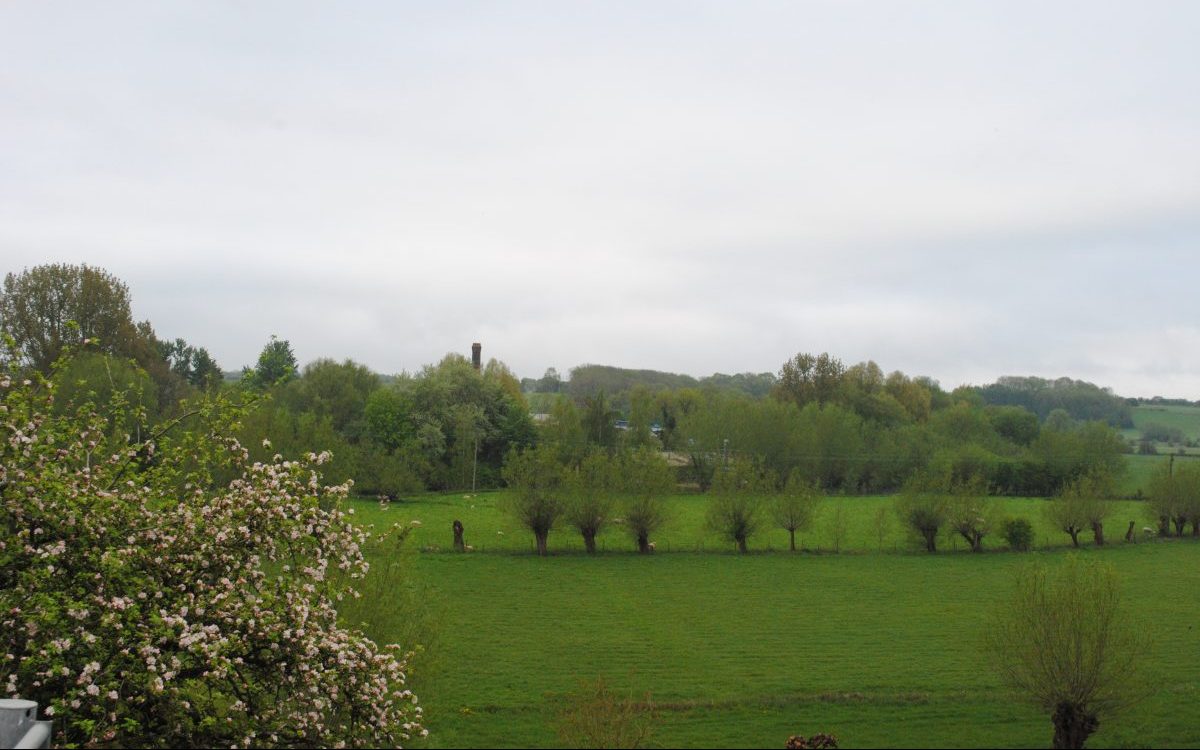
We spent some time at Crawley Bridge, which can usually be quite productive – it’s not uncommon to see grey wagtails there – but the river was very high and we added nothing new. A little after 6:30, while we were admiring the view of the Windrush Valley from the top of Farm Lane in Crawley (one of my very favourite views), Adrian remarked that we hadn’t seen any raptors when a buzzard obligingly appeared on the horizon.
On the way back to Minster Lovell we saw three hares in the same field as some red-legged partridges, confirming my pet theory that if there are partridges, hares can’t be far away.
We usually expect to hear and see between forty and fifty species on a dawn chorus walk but we had only logged thirty-nine by 8:10 when we got back to our cars, so we continued on to the village where we picked up three more to bring the total to forty-two.
In terms of the number of species this may not have been the best dawn chorus walk that I’ve been on but, as usual, I enjoyed the treat of a full English breakfast we had afterwards!
Thanks to Adrian for leading the walk and compiling the species list, which can be found here.
John Cobb 25 May 2023
 WEST OXFORDSHIRE FIELD CLUB