West Oxfordshire Field Club is 60 years old this year. Malcolm Brownsword, who is one of the club’s longest-standing members and a Vice President, has written some personal reminiscences of his time in the club.
[A printable .pdf version of this post can be downloaded here.]
Malcolm writes: When we were reminded that 2023 was the sixtieth anniversary of WOFC, it prompted me to reminisce about the long period of my membership. I believe I joined in about 1969, when I lived in Stanford-in-the-Vale, the village where Pam Ayres lived at the time, and began her career reciting her poems at the folk club based at ‘The Bell Inn’ at Ducklington. Of the current membership, Ken and Brenda Betteridge and Tony Florey are the only members I recall from the early 1970s. Tony Florey told me recently that he joined in 1974. Ken and Brenda were also members of Oxford Mountaineering Club, which I had joined in 1966. Other members of WOFC that I was particularly friendly with in the early days were Yvonne and Roger Townsend, Barbara and Martin Slocock and Graham Wren. As well as natural history, Tony and Martin shared another common interest with me: vintage motorcycles.
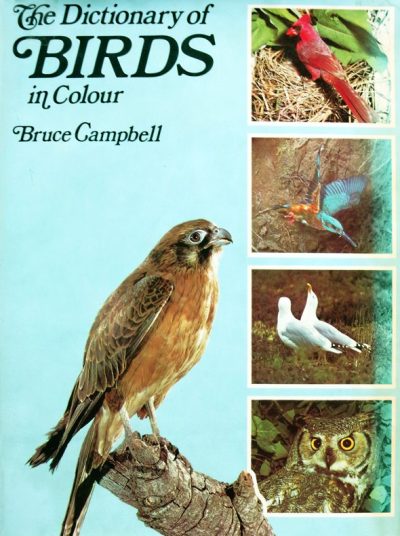
In the early 1970s, The Field Club met on Friday nights in the lecture theatre at Witney College. Officers of the club then included Dr. Bruce Campbell and Dorothy Bolton. The former’s PhD was the first British degree awarded for a study of British birds. He held the post of secretary of the British Trust for Ornithology for 11 years and was editorial advisor on wildlife and conservation for ‘The Countryman,’ then based in Burford. In 1976 he used my photograph of a White Admiral butterfly that I had taken in Oakley Wood in ‘The Countryman’s Britain,’ edited by Crispin Gill. I recall that the fee paid for the image was equal to the cost of the book, so I received a copy of the book! He was also Chairman of BBONT, the forerunner of BBOWT, for a number of years. I still have my copy of his ‘The Dictionary of British Birds,’ a ‘mammoth’ volume published in 1974. When I told him in 1975 that I was going on holiday to Tunisia, he asked me to send him a list of my bird sightings, particularly at a lake called Sebkha Kelbia, the second most important wetland in the country and now a nature reserve. Among the exotic North African species, I saw a single Great Crested Grebe. At the time this was the most southerly record in the world!
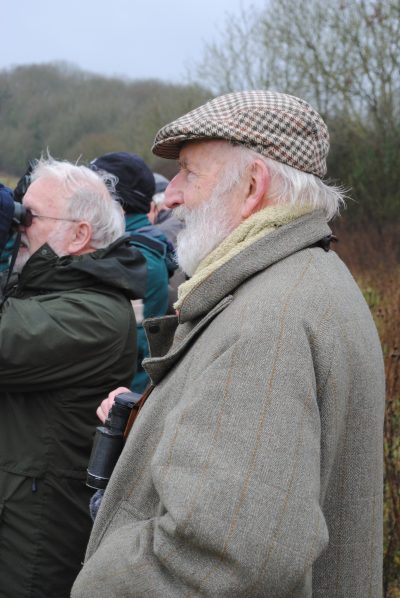
In addition to Bruce, there were two other Campbells. The first was John, who was curator of the County Museum at Woodstock. The second was W.D. Campbell (Bill). He was a retired Head teacher who had a weekly natural history column in ‘The Guardian,’ and a further one in ‘The Oxford Times.’ I recall his leading a WOFC field trip to Wychwood Forest. He was then almost 80 years old and insisted on climbing a tree in order to address his audience below!’
Dorothy Bolton was critical of the fact that BBONT were not very active in the Witney locality. However, I was pleasantly surprised when I heard that she had bequeathed a significant sum of money which was used to purchase what is now ‘The Dorothy Bolton Meadow,’ part of the Upper Ray Meadows reserve. She was a keen gardener, and we exchanged plant cuttings on a couple of occasions.
Many older members would have known Graham Wren, who passed away in 2018. When he was away in St. Kilda, he sent me a postcard from ‘the largest Wren on St. Kilda!’ His knowledge of birds, and in particular their nests, was exceptional. In my time as a member, there have always been members like Graham able to help sort out an identification or answer a question for me. Every now and then I have noticed ‘interest groups’ develop. There has always been a bird group and a flower group but in the last couple of years a Bush Cricket group seems to have developed, thanks to the adoption of modern bat detectors, which can also be used to detect insects.

My main memories of the club’s activities are of the field trips. Particularly memorable to me are those we have visited frequently, such as Otmoor and Chimney meadows, where there have been great changes over the years. I remember seeing scores of Marsh Fritillary butterflies on an evening visit to the rifle range area at Otmoor in the early 1970s, yet they are now locally extinct, but there is still plenty of Dyer’s Greenweed present. In the spring I used to see many redshanks close to Chimney Meadows but for decades they have been scarce, but following lots of work by BBOWT I am told that they are now recovering in numbers.
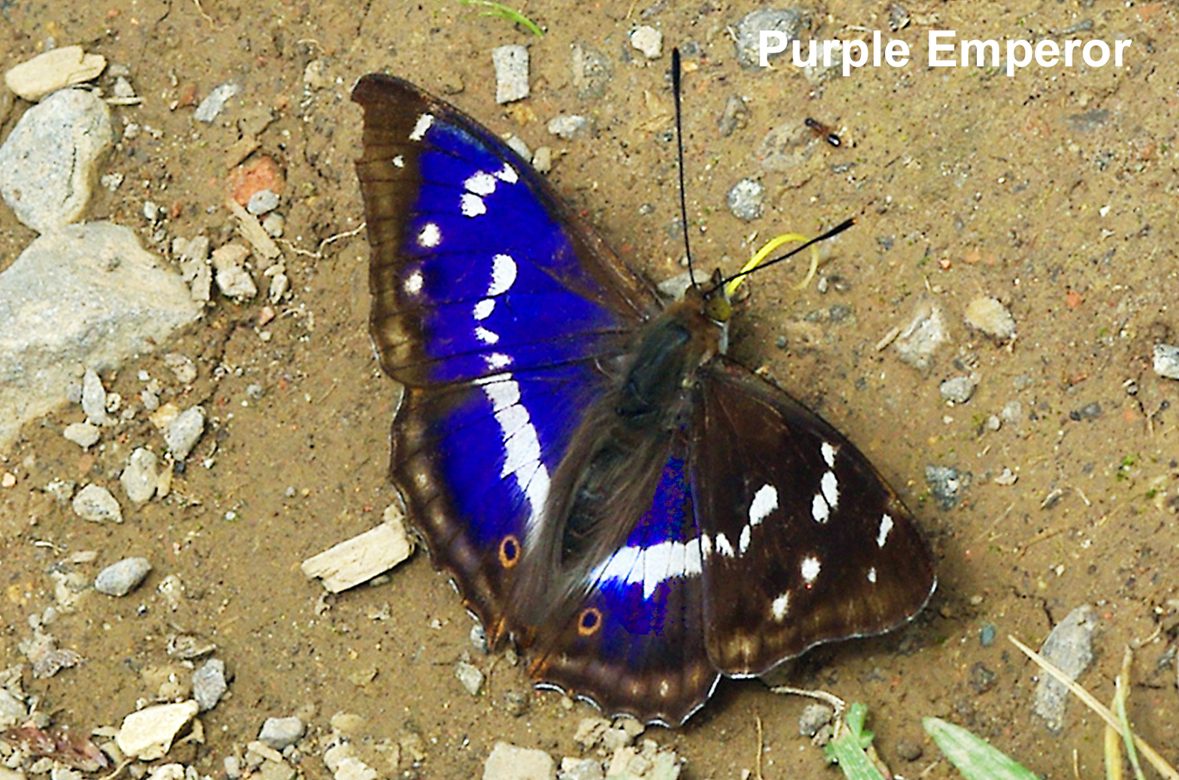
In most years, in early July we made a visit to Oakley Wood (it was always referred to as Bernwood Forest – strictly speaking Oakley Wood is a remnant of what was the very large Bernwood Forest). There was always a chance of seeing a Purple Emperor or White Admiral here. One year, camera in hand, I remember accompanying Barbara Slocock as we ran in pursuit of a male Purple Emperor for some distance along one of the rides. Needless to say, neither of us succeeded in obtaining an image (main picture). Fortunately, in recent years I have managed to be more successful!
Other spectacular butterfly experiences I recall on WOFC field trips include seeing scores of Dark Green Fritillaries at Cleeve Hill about 20 years ago and seeing hundreds of migrating Painted Ladies flying in an almost due north direction over Lardon Chase, Streatley during the May bank holiday weekend in 2009.

One of the delights of returning to Oakley Wood is to visit the same Wood Ants’ nest I have been visiting for at least 4 decades. This image was taken in July 2011 on a WOFC field trip. Another favourite present in this wood is the Wild Service Tree. There are a few score of this beautiful, uncommon species present, particularly in the area on the butterfly route known to Butterfly Conservation members as ‘Piccadilly Circus.’ The local Forestry Commission ranger told me that they regenerate naturally. Some are sold, and others transplanted to other parts of the wood.
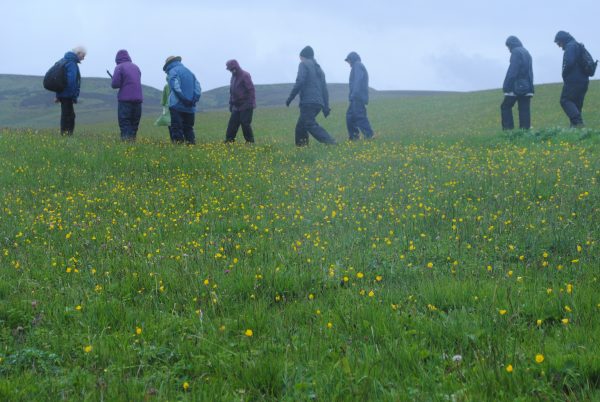

Although over the years there have been many long weekends spent by WOFC parties in various parts of the country, it is only in the last few years that I have been on any of these trips, to Upper Teesdale in 2019, mainly to see its alpine as well as other flora, and to The Somerset Levels in 2022, when we saw a wider range of wildlife. Each was led by Peter Creed, whose knowledge of the natural world can only be described as exceptional. Both trips were well-organised, and the accommodation was excellent. This year Peter is leading a two-day fungus foray in the Malvern area from 29th-30th October. Details to be announced.
Malcolm Brownsword, May 2023
Members are reminded of the Club’s 60th Anniversary Lunch at FarmEd on Thursday 3 August 2023.
Members are encouraged to send reports of items of interest – some text and a photograph – to: Blog(at)thefieldclub.org.uk
 WEST OXFORDSHIRE FIELD CLUB