Perhaps it was too hot, but only four people joined Jan Guilbride for an extremely interesting two-hour stroll in the Pauline Flick reserve, near Great Rollright, on the morning of Sunday 25 June.
The half-mile path through the reserve winds its way along the disused Cheltenham to Banbury railway line, which closed in 1969. This stretch of line had a number of owners after its closure and was monitored locally by Pauline Flick who lived at Limekiln House. Pauline died in 2001 and the site was given to Banbury Ornithological Society in 2001. Jan Guilbride has been Reserve Manager since 2018.
We headed up the path quietly, looking for any wildlife and plants of interest. At the far end, Jan discussed the history and use of the site and her thoughts about management, which involves tractor mowing and hedge flailing in September each year to allow access and also to control invasive plants such as clematis, hawthorn and brambles.

Jan has cleared large swathes of the path to allow for light while keeping short stretches of shade to encourage a diversity of species. Hawthorn predominates if it is allowed to, so much of it has been cut back and other tree species planted. As a result, there is a rich diversity of both plants and wildlife.
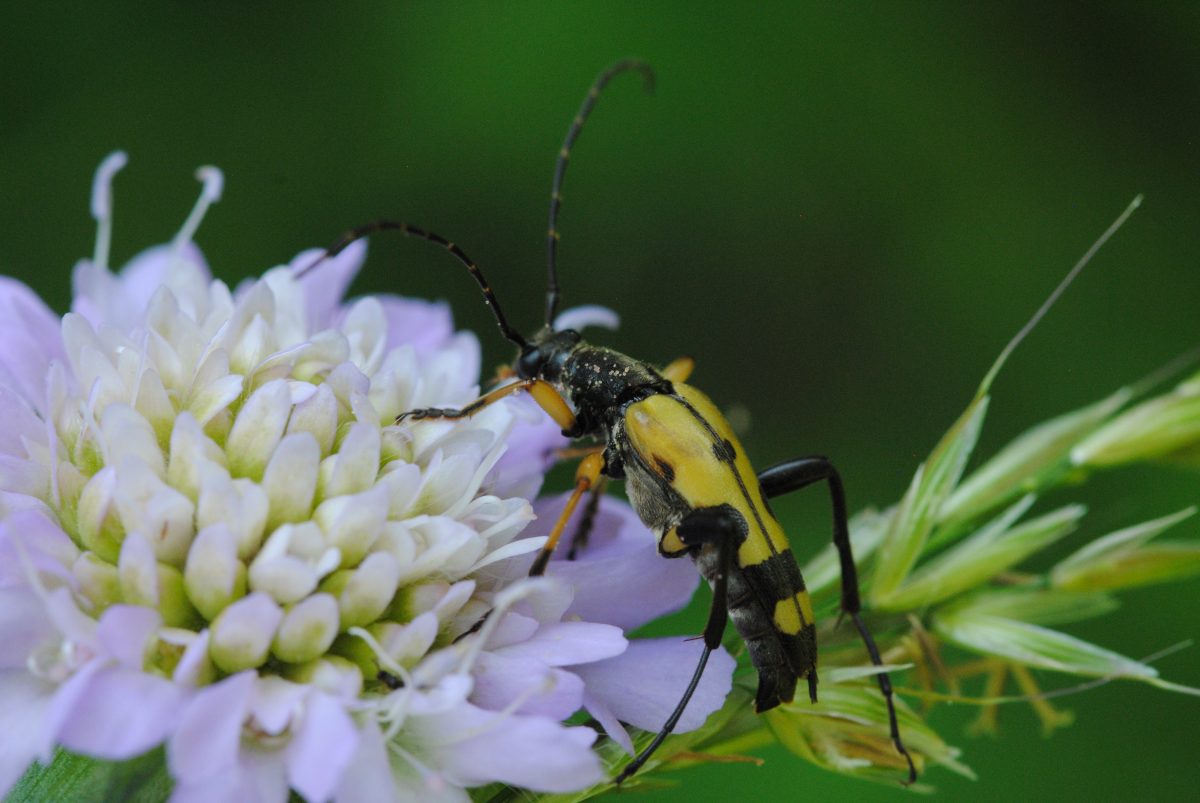
Although it was midday and the birds were quiet, there were several speicies of butterfly active, as well as a variety of hoverfly species; a black and yellow longhorn beetle was feeding on a scabious. A few twayblades – past their best – were growing in the shadier places as well as a fair number of common spotted orchids, all protected from mowing. The reserve also supports a colony of glow-worms, which seems to be spreading, and we spent some time discussing how best to manage the reserve for them.

Two interesting examples from Jan’s collections of findings were cherry stones nibbled by wood mice and a harvest mouse nest found attached to a blade of grass in the autumn. Management of such a site is constant but the results are well worth the effort. A bird count is undertaken every three to four weeks.
The advantage of being such a small group was that Jan could talk at length about the reserve and discuss options for its management. Should there be more or less intervention? Should access only be allowed with permission? What to do about Ash die-back?
We all thoroughly enjoyed the morning and learned much more than can be noted in this report. Many thanks to Jan for giving up her Sunday morning to show us the reserve.
A species list can be found here.
Julia Reid 26 June 2023
 WEST OXFORDSHIRE FIELD CLUB