
Brenda Betteridge, a long term member and one-time Newsletter editor of WOFC, has written some of her memories of the early days of WOFC [which seemed to be rather more adventurous then!]
Memories of my early days as a West Oxon Field Club member: [a printable .pdf version (without pictures) is available here]
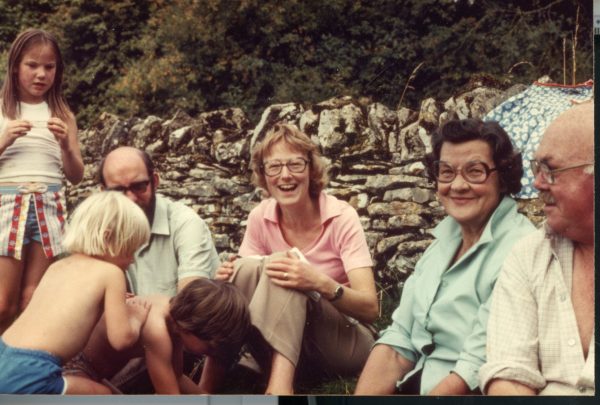
Ken and I joined WOFC either in 1974 or 1975. We heard about the club from Fay Brown, who was a member with her husband Bob, when she, in her capacity of health visitor, visited me regularly after our first daughter, Lynn, was born in 1974. In those days the indoor meetings were held in the lecture theatre at the West Oxon College. When our daughters were old enough, they came with us to the indoor meetings. They sat at the back of the lecture theatre with things to amuse them. They also accompanied us on outdoor meetings. One day as we were gathered in a field gateway Ken showed off his 5-year-old middle-daughter’s ability to identify plants. He pointed out one of the plants at our feet and asked her what it was. She did not let him down and correctly identified it as Pineappleweed after bending over and smelling it!
Joining the Field Club opened up a new world to us. Already a keen botanist, through the Field Club, I expanded my knowledge about plants both locally and further away at flora hot-spots. On field meetings we learnt from each other as we shared our love of the natural world. We were also fortunate to have several well-known experts in the Club who were happy to share their knowledge, e.g. Marion and Arthur Warland, who were the Oxon County Recorders of fungi, took us on some delightful fungus forays; and Gwen Allen, who wrote the ‘Clue Books’ (natural history books for children) published by Oxford University Press.
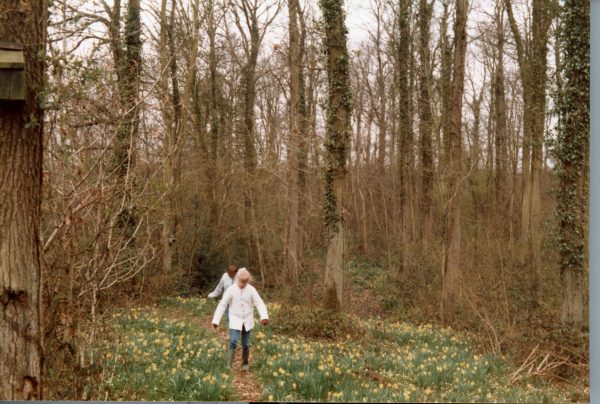
Memorable locations for field meetings were: Otmoor where we were greeted by Nightingales singing their hearts out – this is the last time I heard a Nightingale; a Gloucestershire wood where Dr Bruce Campbell was monitoring Pied Flycatchers – I wonder if they are still there; a wood near Bledington where there was a beautiful carpet of blue anemones (Anemonoides apennina); Ditchley Estate for an extensive display of Colchicum autumnale; Barnsley Warren for Pasque Flowers; Betty Dawes Wood, near Dymock, for wild daffodils, and Sherborne where at dusk we watched Greater Horseshoe Bats leaving their roost and Daubenton’s Bats skimming low over the river catching insects.
At every indoor meeting, just inside the door, was a display of photographs and artefacts illustrating the talk of the evening put together by Avery Baines, who at that time was the Programme Secretary. She must have had a big supply of pictures cut out of magazines! Enjoyable talks I recall were given by Joe Henson (father of Countryfile’s Adam) about rare breeds, Gordon Langsbury, a wildlife photographer, Ray Goodwin, a wildlife recordist, Ken Jackson, a wildlife broadcaster on BBC Radio Oxford, and not forgetting our own Graham Wren with lots of photos of birds eggs in nests!
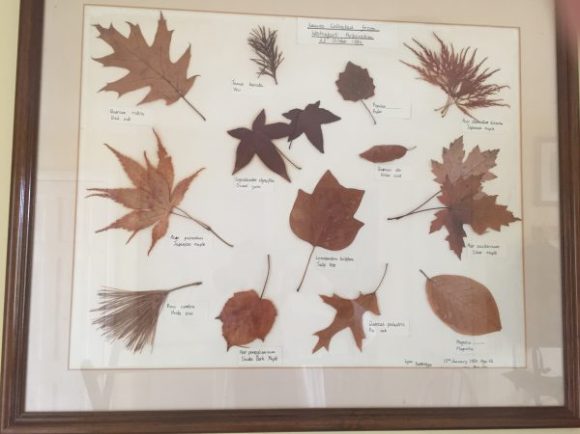
We always looked forward to Member’s Night, the one meeting a year when we were allowed to have refreshments in the lecture theatre. Members brought along slides of photos taken on field meetings, or interesting holidays, to share with other members. One year, after we had holidayed in the Pyrenees, Ken showed some slides of an eagle which had been soaring below us. These were photos Ken wished he had been able to show but his camera was not working at the time. He put through one slide after another and talked about them facing to the audience. Of course, I was in on the joke, and it was funny observing members trying to tell Ken that no pictures were being projected onto the screen! In Member’s Night in 1985 there was a competition for children which Lynn, aged 10, entered and won first prize (I can’t remember what that was) with a display of pressed leaves, which she had collected from Westonbirt Arboretum, and identified. Ken had this framed, and it now has pride of place in our hall. Yes, in those days Family Membership included children!
We really enjoyed the trips away with the club when we left our daughters with my mother. One of the first was to Pembrokeshire, the highlight of which was a trip to Skomer. As we could not afford to stay in the guest house with the other members, we camped in the garden of the manager of the nature reserve we were visiting. We did enjoy the trips and went whenever we could. Particularly memorable were the trips led by Peter Creed to Breckland, Teesdale, Derbyshire, Somerset and the Wyre Forest where, thanks to his expertise we were introduced to many rarities, in the early days mostly plants but as Peter widened his range of expertise, mosses, liverworts, fungi, birds, butterflies and insects. We also enjoyed a trip to Rutland and saw the Red Kites in their pens getting ready for their release at the beginning of the reintroduction programme.

We made the effort to join one Dawn Chorus – the last one that Bill Campbell lead in Wychwood Forest. We were so pleased we did as it was rather special to be in this location at that time of the day. That morning Dorothy Boulton, the Field Club secretary, after arriving at Five Ash Bottom in her mini, discovered her house key on the roof of her car. How it has stayed there round all the bends on her route from her home in Charlbury is a mystery!
One day when I was shopping in Witney I bumped into Dorothy, who, when we stopped to chat, asked me if I would like to be on the committee. What an honour! In those days committee meetings were social occasions and the business fitted in around the chit-chat. Chris Bartrum always gave us a glass of wine. Refreshment provided by Barbara Slocock when the committee meetings were held at her home were delicious and extensive – you certainly did not need a meal before going to those meetings. Dorothy, too, was a good cake baker. She gave me her recipe for what is known today as ‘Millionaire’s Shortbread’. I’m afraid it was rather poor does when it was my turn to host the committee meetings!
We had some very memorable summer parties. In the early days we did our own catering with members contributing to the delicious buffet. Somehow, we always ended up with little food over and a good range of dishes, probably because Barbara Slocock master-minded the event. At first, they were held in members’ homes. The first one we attended, when it was called a Social Evening, was in the home of Mrs Jessie Bartlett in Burford Road, Witney. Other venues included Clanfield Primary School, where member David Holme was headmaster, and Cokethorp School. The Silver Jubilee Party was held at Weald Manor, the home of Major Coville, where we could look round a lovely garden. One was held at Kelmscott Manor. How that was organised I have no idea as we were taken to the venue from Radcott Bridge on the River Thames in a boat, which if I recall correctly was called ‘The Fair Rosamunde’. One member’s signature dish was a beetroot salad which was made with a raspberry jelly and vinegar – delicious if eaten with the other savoury dishes but not as a dessert – a mistake one member found to her dismay!
Over the years we led many walks. A favourite was from our home in Worsham Lane which took us on a circular route via Asthall and back for tea and cake. On one occasion when we were nearly back the heavens opened. Nobody was prepared for rain so on reaching home people changed out of their wet outer garments and sat round the dining room table wearing their waterproofs! We enjoyed taking members to local places of interest, e.g. Great Tew to see the snowdrops and aconites; and Westwell Gorse Nature Reserve, which we managed for BBONT, to show members the two rare plants which grow there (Downy-fruited Sedge and Purple Milk-vetch).
For many years, when we lived in Worsham Lane, we enjoyed hosting the Moth Evening. Three moth traps were set up: one in the disused quarry on the north boundary, one in the orchard and one on the lawn near the house. At dawn Ken got up and put towels over the traps to stop moths escaping. One balmy evening several members joined us in the garden to see the moth traps set up and stayed after the sun set to see what moths were about at dusk. The next morning members were back again to see the moths, which had been caught, identified and counted. It was lovely to see the moths close up and see what beautiful creatures they are.
Brenda Betteridge (former Newsletter Editor) 22 July 2023
 WEST OXFORDSHIRE FIELD CLUB