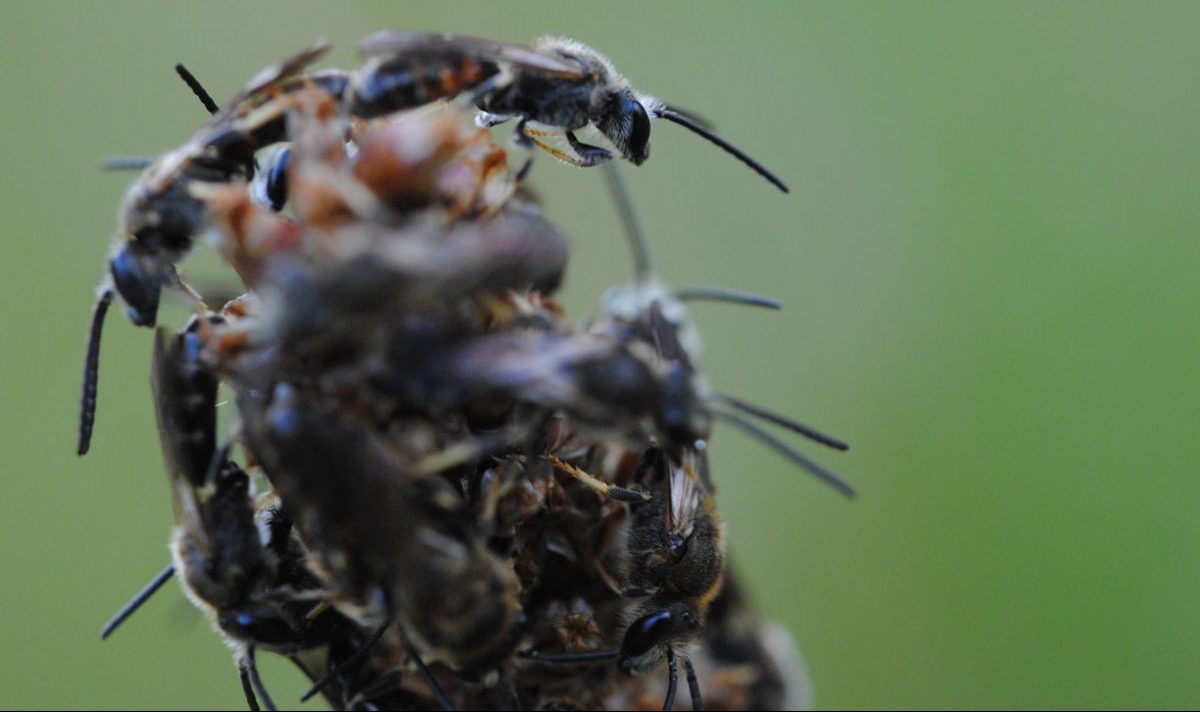
John C writes: Our recent post about the solitary bees in Sue’s garden (Intrigued by Bees) stimulated quite a lot of interest amongst members, so a (rather belated) update seems in order.
Within a day or two of posting our observations, I had been lent a copy of The Hymenopterist’s Handbook (1944 edition), sent some references on the importance of plantains in the diet of honey bees, and one of our members even got in touch with Dave Goulson, the UK Bumblebee expert to ask what the bees were doing! (More below.)
Over the next couple of weeks we – mainly Sue – kept an eye on the bees, who departed regularly in the mornings around 8am and returned around 6 or 7pm in the evenings. We didn’t see any in the garden – which has plenty of bee-friendly flowers – during the daytime and don’t know where they went. Presumably they went somewhere in search of females.
I scythed Sue’s ‘meadow’ area of garden on 16 July, but left a couple of square metres with plenty of plantains. We were worried that after most of the long grass had been cut the bees would have lost some cues to the site but, to our relief, they returned more or less on time in the early evening.
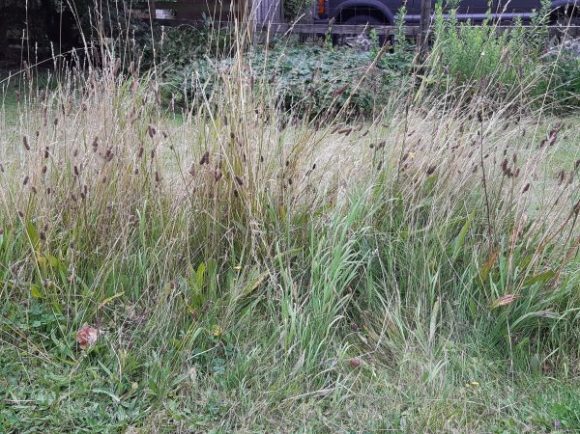
It was difficult to count the number of bees, and how the number changed, although I would say that it possibly increased slightly during the first couple of weeks. In any case, I estimate that there were a few tens of them and on one or two evenings (at least) they covered more than one plantain head. A few of them succumbed to a small spider, which was ‘relocated’. (I’m not sure that you should interfere with Nature….)
We never found the nest sites. They could have been anywhere in the local suburban gardens or road verges, or even the nearby allotments. (To be honest, we didn’t try very hard.) The last time we saw the bees in any number was on 21 July. The following day it rained heavily all day and only a very bedraggled few returned in the evening; after a couple more days they had all vanished. My guess is that they were already reaching the end of their natural life, which is (apparently) only a few weeks, and the rain and cool weather finished them off. We had been watching them for four weeks, which must have been a good part of their lives.
Dave Goulson pointed us to page 432 of a recently published book: ‘Solitary Bees‘ by Ted Benton and Nick Owens in the New Naturalist series. The explanation for the clustering together seems to be that the males roost collectively to keep warm – the females may retreat alone to their burrows overnight. According to Benton and Owens, another possible explanation is that the clustering of the males of this species (Lasioglossum calceatum) may function as a lek to attract females, although we didn’t notice anything that looked like mating behaviour.
In the end, the bees made a fascinating, if rather unscientific, little study. It was sad when they disappeared because we had become rather attached to them. We’ll certainly keep an eye out for them next year. On the plus side I now have a copy of Benton and Owens, which weighs in at 595 pages and at least a kilogram; I have not yet read it from cover to cover!
With thanks to AS for the handbook, TK for the references and GT for contacting Dave Goulson.
John Cobb 16 August 2023
 WEST OXFORDSHIRE FIELD CLUB