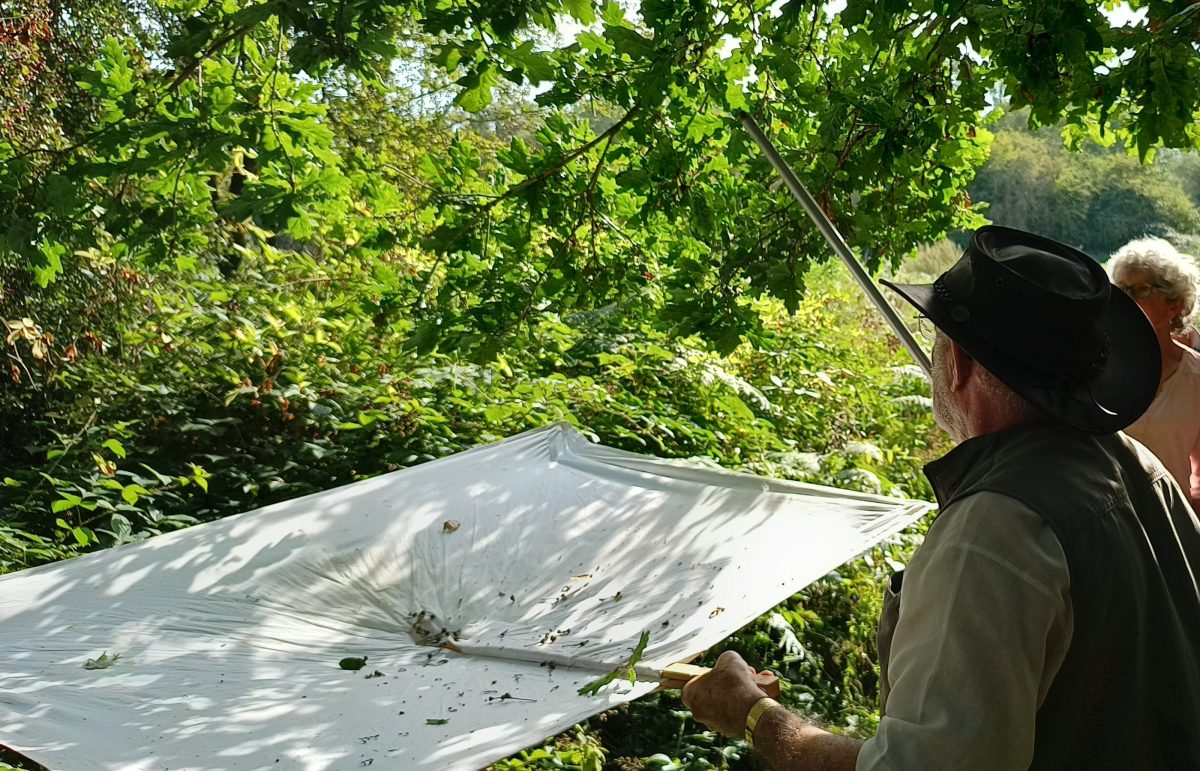
On the mercifully cooler afternoon of Sunday 10 September following a week of temperatures regularly reaching 30 degrees C, a group of non-arachnophobes assembled at North Leigh Common for an excursion led by Lawrence Bee. Lawrence’s background was in ecological and environmental education, and he developed specific interests in spiders and insects, and has co-written several beautifully illustrated books on the subject.
We were introduced to the various methods used for sampling and monitoring. These included an ingenious method for temporarily securing a specimen which involved the use of two transparent plastic pots, some cling film, and high-density polystyrene foam; a modified garden leaf-vacuum which sucked specimens into a net bag; an inverted umbrella-like contraption which, when held under the branches of a tree, collected whatever fell out when a branch was shaken and, more conventionally, fabric nets which collected specimens when whisked through the vegetation.
It has to be said that your reporter was somewhat daunted by Lawrence’s extensive knowledge of his subject given the vast and varied number of different families, genera, let alone species, that exist among the spiders, bugs and insects!

We easily found numerous specimens which were tipped into white trays to help make them more visible. There follows a beginner’s random list of a few of the many fascinating specimens seen and issues discussed:
There are six species of house spiders. If you put a house spider outdoors it will try to come back in!
Eye patterns are used to identify some species. Cleary this must be done under a microscope back in the lab.
Wolf spiders do not make a web, they catch their prey by out-running it.
Metellina segmentata (aka meta segmenta, Lesser Garden Spider), which is abundant in the UK, has a distinctive ‘tuning fork’ pattern on its carapace and is venomous [but not to humans].
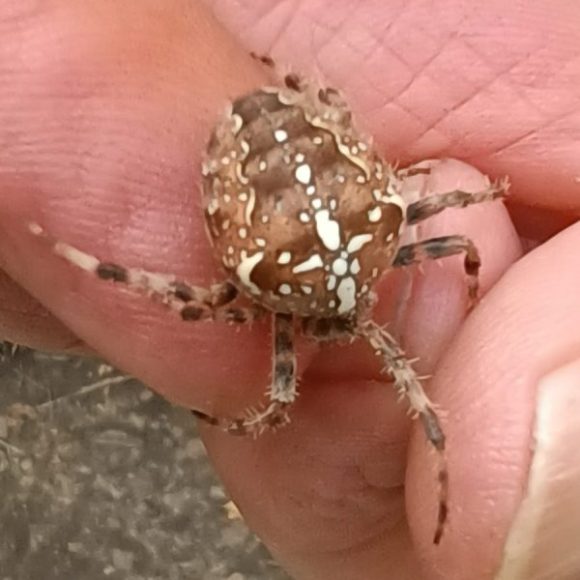
Garden spiders have a large abdomen and always have complex white markings; immature specimens are rarely able to be identified since their specific individual features do not appear until adulthood. The one in the picture is Araneus diadematus, recognisable by the white abdominal cross.
Running crab spiders, like many others, do not spin webs;
Orb web spiders are the only ones to have a web with a solid centre. Web spinning spiders usually have an open centre for the spider to lurk in.
The species Hypthiotes parxadoxus is non-venomous but catches its prey in a triangular shaped taut web which collapses and enwraps the prey, which is then injected with an enzyme which liquifies it so that the spider can suck it dry!
Although this report has not met the normally high scientific standards of the Society at least it records a very informative and enjoyable excursion. [Methinks he’s too modest! Ed.]
John Baker September 2023
The species list can be found here.
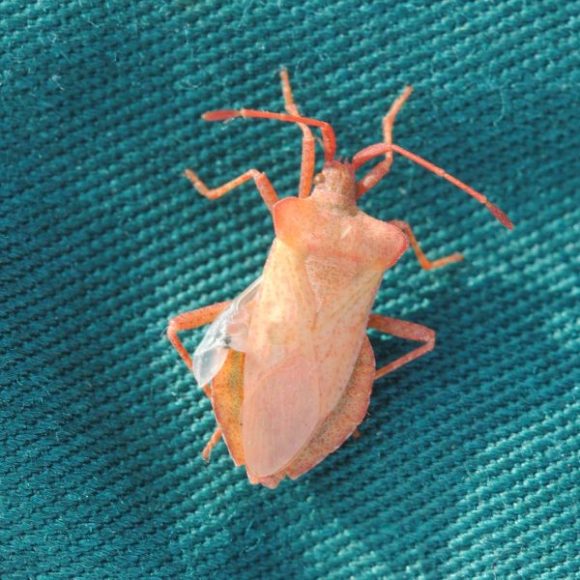
John C. adds: Although the focus was mainly on spiders, we did catch a few insects. One that had us very puzzled was a Shield bug, very similar to a Dock Bug but translucent pink. Some research on britishbugs.org.uk showed that it was, indeed, a Dock Bug, Coreus marginata, but a ‘teneral’ adult, that is an adult just emerging from its final moult from the last nymphal stage; its skin would not have fully hardened or assumed its final brown colour. In the picture below it looks as though it’s still hardening its wings.
 WEST OXFORDSHIRE FIELD CLUB