Thirteen of us met with leader John Baker in Stonesfield Church car park on the grey but dry Sunday morning of 17 September. Owen Green from the Oxford Geology Trust came along too, so we had a full quota of Geology experts! Thus began a fascinating and rather exciting morning of discovery.
Before setting off, John showed us examples of marine fossils that have been found in the Stonesfield area. This got our eye in for what to look for on our walk. He also gave us each a handout containing explanatory diagrams and information [downloadable here].
We moved to the Churchyard where we could see a good example of Stonesfield slate roofing. John pointed out gravestones made from iron ore, noticeable by their rust colour and the way the engraving is still very distinct and unweathered, unlike limestone gravestones. Iron ore was quarried in Fawler where there is, apparently, a tunnel underneath the road, (yet to be discovered!)
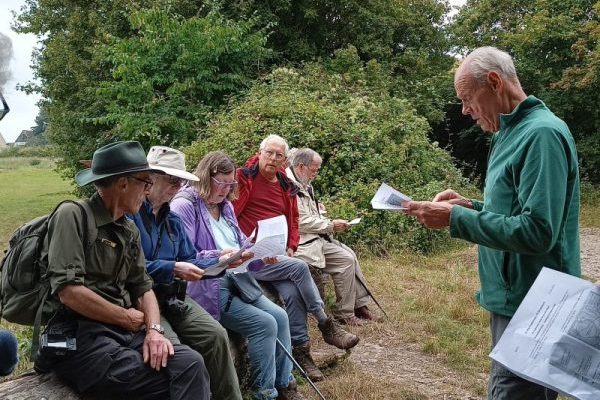

John planned our walk so that there were three stopping points:
The first was in a glade on the top of the hill where there are numerous examples of chippings from the creation of slate tiles. Many of these contain marine fossil remains and we found several different examples of these.
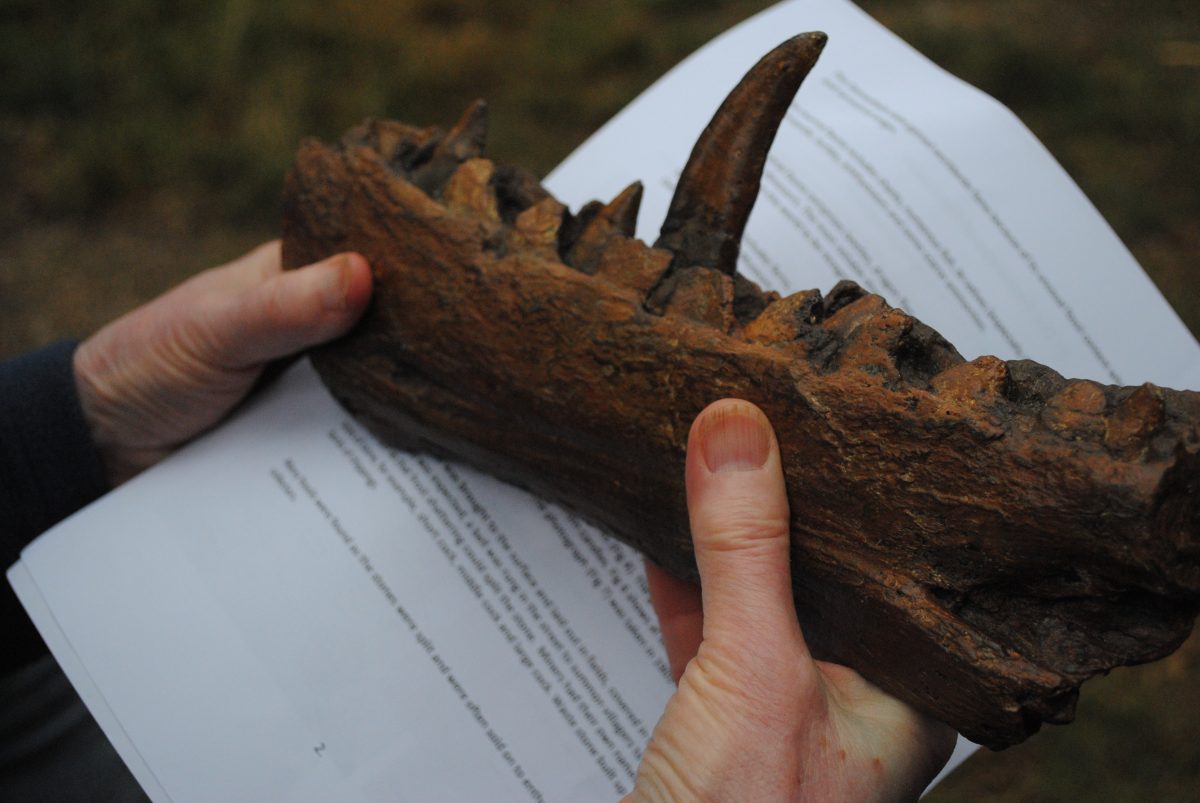
Shortly afterwards we sat down on some logs at an entrance to what is sometimes known as ‘The Dinosaur Field” where there is an information board. John then produced the lower jawbone (actually a replica!) of a Megalosaurus, Megalosaurus Bucklandii, which was found in the area and was the very first dinosaur to be scientifically described. It was carnivorous and about eight metres long. The Stonesfield area was a rich source of not only fossils but bones of prehistoric animals and the local slate miners used to supplement their income by selling them. The original Megalosaurus bones are now in the Oxford University Museum of Natural History.
Walking down to the river we learned about the Geomorphology of the area and how the steep banks of the valley were created from the melted water at the end of the peri-glacial period of the Anglian period, 400,000 years ago. The smaller valleys were tributaries for the same huge mass of water.
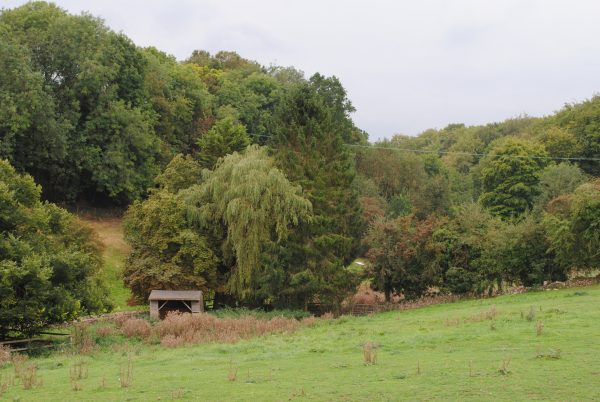

Our third stop was by Spratts Barn, now a private house, the site of a slate mine, (now covered over), where a tunnel, about 3-4 feet deep runs in a semi-circle under the road. It must certainly have been a tough life for a slate digger, digging out and then lifting heavy slate in all weathers. Their job wasn’t finished until they had split the slate into tiles and then drilled a hole by hand for roof hanging.
This was a really enjoyable and informative outing, much appreciated by all who came along, so many thanks to John Baker.
And then, at 2pm, right on queue according to the Met Office, it rained. Perfect timing!
Julia Reid 18 September 2023
 WEST OXFORDSHIRE FIELD CLUB