
Jean Thompson writes enthusiastically about a few days she recently spent in Scotland: I’ve just returned from a three-day break in Scotland with my sisters, staying with one sister in Crieff before travelling to Pitlochry to meet the other. We all have a variety of interests, including the natural world so all enjoyed our trip to Faskally Woods.
This ‘model woodland’ was created in the nineteenth century under private ownership but is now the responsibility of Forestry and Land Scotland. It is situated within the Tay Forest Park, on the banks of Loch Dunmore, about a mile north-west of Pitlochry.
The area is made up of Pre-Cambrian Dalradian rocks from about six hundred million years old. These originated from sands and muds that were deposited in the ocean at the edge of a continent. These were strongly folded and metamorphosed, for instance into schists, like those at Faskally, as the ocean closed and the two opposing plates collided.
These contrast with the Old Red Sandstone (Devonian) rocks around Crieff, which are only three hundred and fifty million years old, south of the Highland Boundary Fault, over which we passed on our way to Pitlochry.


We saw a couple of birds, too fleetingly to identify, but we used our bird song identifiers to record Eurasian wrens, carrion crows, rooks, moorhens, chaffinches and a Eurasian Jackdaw.
One winged creature we did see was the Common carder bumblebee.
Perthshire is known as Big Tree County (unbeknownst to me until a few days ago!) and that was certainly in evidence all around the Pitlochry area. There are apparently more than twenty tree species, with plenty of tall conifers in Faskally Woods, including Douglas fir, European larch, Norway and Sitka spruce, Western hemlock and Scots pine. That’s not all, though, the forest is well and truly mixed, with plenty of beech, silver birch and wild rhododendron. We even saw some oak (Northern red and English), elder, sweet chestnut, mountain ash, elder and holly. In addition to the well-established trees, there was also evidence of saplings and other new growth.
Apart from the trees, we saw a multitude of other flora, from ground cover to shrubs. Some I recognised, others I had to identify using some of the apps on my phone. These included: Red clover, Common foxglove, Common wood sorrel, Forget-me-not, Hedge woundwort, Scotch heather, Yellow flag, Common comfrey, Common polypody, Common nipplewort, Fox and cubs, Herb Robert, Broad leafed willow herb, Ragwort, Common wood sorrel, Elm leaf blackberry, Western swordfern and White water rose (only known to me as water lilies previously!)
We were told that the forest boasted a large number of fungi but we only saw these examples:, Hydnangiaceae (decievers), Orange birch bolete, Bracket polypores.
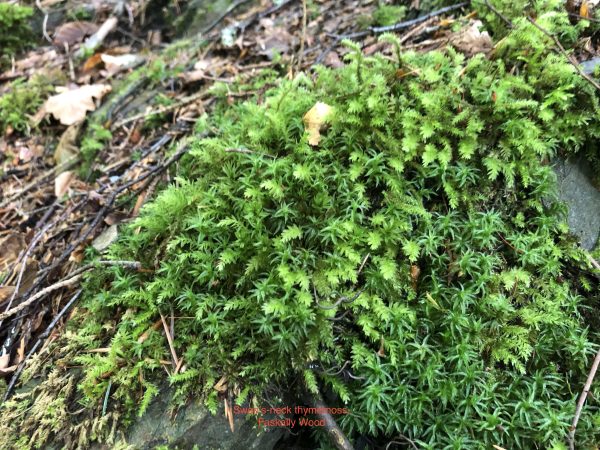
There were loads of mosses, but I only managed to identify a few: Krauss’s clubmoss, Red-stemmed feather moss, Swan’s-neck thyme-moss and delicate fern moss
All in all, Fiscally Forest provided us with a great morning and I’d love to go back at some point to enjoy the whole experience again.
Jean Thompson 12 July 2024
 WEST OXFORDSHIRE FIELD CLUB