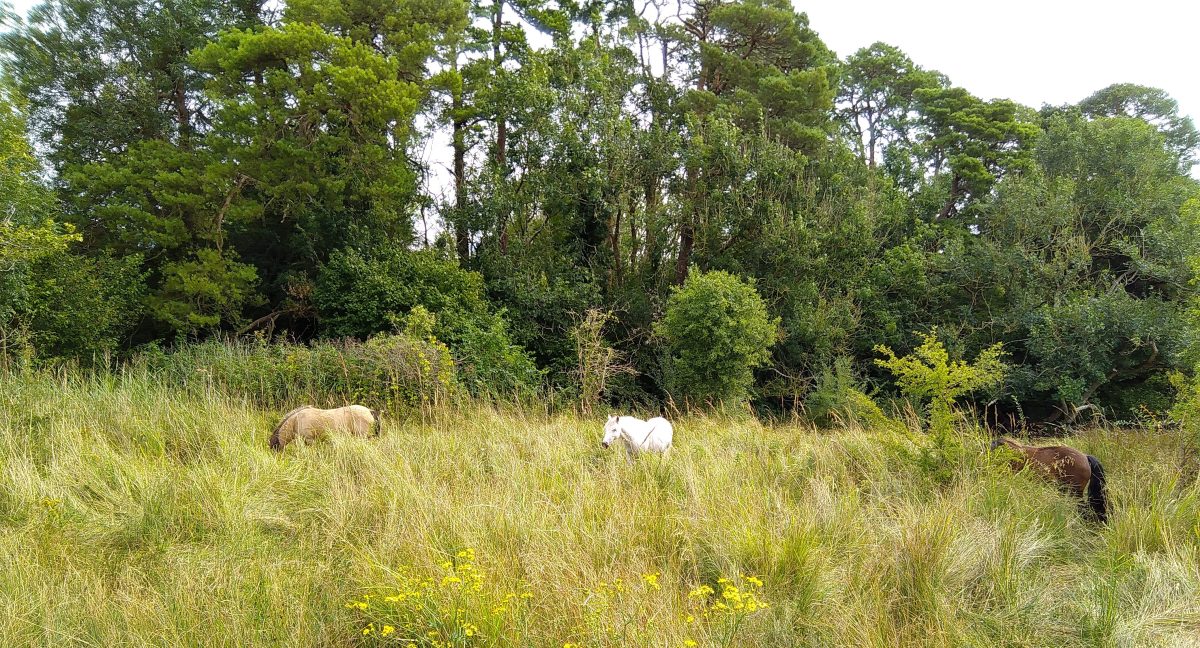
Visit to Parsonage Moor Sunday 25th August 2024
Julia Reid writes:
We were so lucky to have chosen Sunday for this visit. Saturday had been a day of relentless heavy rain and would have been miserable. Instead, we were treated to a day of cloud but no rain and although paths were damp, with puddles in places, they were perfectly navigable. So twelve of us set off, led by expert naturalist and photographer Peter Creed for what turned out to be a fascinating and really enjoyable morning. Grass of Parnassus was what we were hoping to see, but there was a lot more, and some suprises too.
Crossing the road from Dry Sandford Pit, we headed up a lane where Peter showed us tiny silver ‘Dolly flies’ hovering fleetingly over the puddles. We then turned into Parsonage Moor, a boggy fenland area of tussocky landscape, through which runnels of water run and which is covered by rushes and mosses. The area is grazed by wild ponies which were doing a great job keeping the vegetation at bay.
A mixture of limestone and sand, with areas of peat, has led to a varied mixture of plants. The plant we hoped to see, the Grass of Parnassus, was in bloom, with large white green-veined flowers on a single stem. Apparently, the Greek physician Dioscorides recorded the plant on the slopes of Mount Parnassus, sacred of Apollo, in the 1st century AD. This is surprising when the plant prefers a watery habitat!
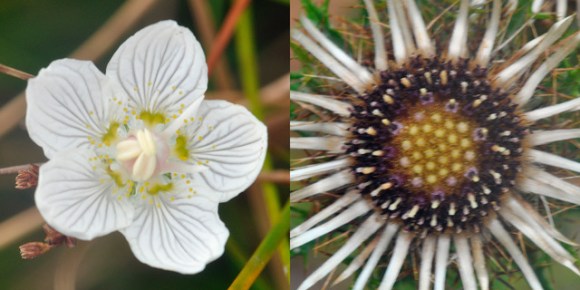
Another unusual fenland plant identified by Peter was Parsley Water Dropwort, which is particularly poisonous, possibly more toxic than hemlock. We learned how to differentiate between Marsh Bedstraw and Fen Bedstraw, the latter having backward hooks, like Cleavers, on its leaves and we also noted that Black Bog Rush is actually a Sedge!
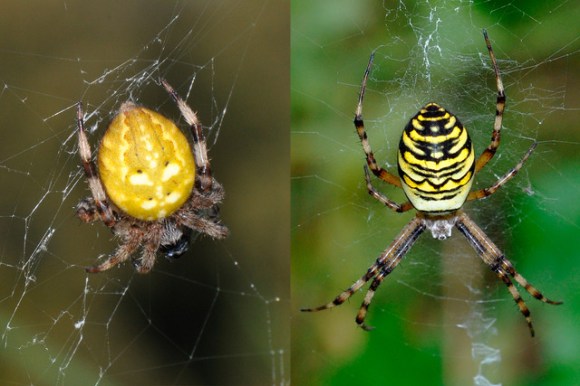
In among the fenland plants we were also very pleased to find Long-winged coneheads (a type of bush-cricket) and two beautiful spiders, the Wasp spider and Four-spotted Orb Weaver. The list of insects and arachnids can be seen here.
Leaving Parsonage Moor, we walked up towards Hitch Copse, stopping to look at a Large leafed Lime. There are two other varieties of lime, Small Leafed and Common Lime, the latter being a hybrid and the one on which Mistletoe grows.
Further on Peter demonstrated how ‘buzz pollination’ occurs. Bumble bees hover over low hanging flowers and the frequency of their wing flap releases pollen. Extraordinary.
Because it was cool and cloudy, we saw fewer insects than perhaps we had hoped, however we did spot a beautiful and unusual yellow ladybird and later a magnificent Red-legged Shield bug.
The path eventually opened onto a limestone quarry ‘Oxfordshire’s Breckland’. Carline thistles grew alongside us as we descended. Apparently this area was still under water in May of this year and as a result Water Plantain and Cudweed, both moisture loving plants, were abundant.
There was evidence of solitary bee activity in the sand but none to be seen, nor was there any sighting of a wasp common to the area, which predates honey bees. We hope to return to see this and other varieties of insect in June next year.
Finally we took the circular path back to Cothill, having enjoyed a really interesting and illuminating Sunday morning. The plant list can be seen here.
Many thanks to Peter who made it all so fascinating.
Julia Reid
Birds: Jay, Chiffchaff, Green Woodpecker, Ravens, Carrion Crow, Wood Pigeons
 WEST OXFORDSHIRE FIELD CLUB