
27th October 2024
Julia Reid writes:
Sometimes things go just right and our day out with leader John Baker was just one of those days. We had really hoped for a dry day so that we could enjoy the views of the Golden Ridge and it could not have been
more perfect.
Sixteen of us met in Faringdon and before setting off, John gave us an introduction to the local geology. He explained how, during the Jurassic and Cretaceous periods, deposits of clay formed in deep water, while
more resistant limestones formed in shallow water. Over time, erosion has resulted in the landscape we see today, with Oxford clay to the north and Kimmeridge clay to the south. The Jurassic limestone of the Golden
Ridge, Corallian limestone, containing high concentrations of coral, is sandwiched between the clays. The Cretaceous Chalk downs lie further south.
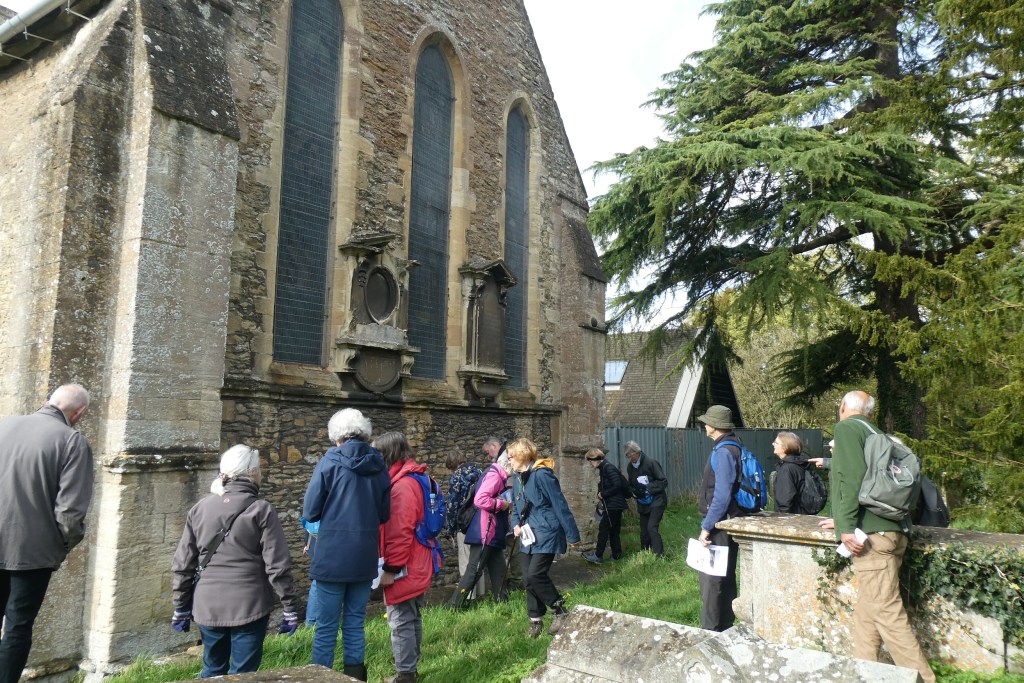

Close examination of the walls of the Bell Hotel revealed excellent examples of the fossil fragments within the Corallian limestone mentioned above.Walking through the town we noted the paving in the Market Place, made of Silurian ‘slate’, after the Silurian tribe in Wales where the rock was first studied. At 400 million years old, it predates the Corallian limestone by almost three million years.
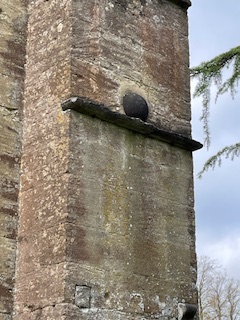
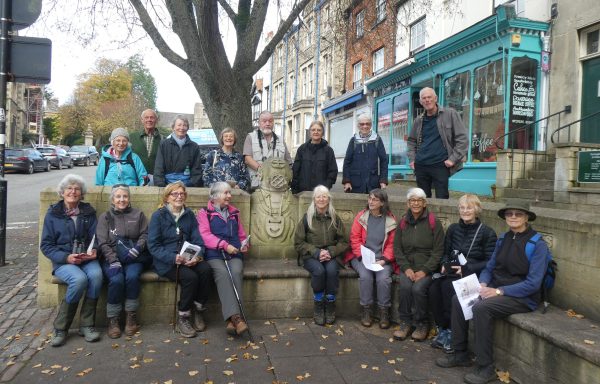
An intriguing selection of oddities was pointed out as we walked, such as the cannon ball, embedded in the church tower, dating from the Civil War, and a sculpture of a diver’s helmet on a stone bench celebrating
Salvador Dali. He was a frequent guest at Faringdon House and apparently walked through town wearing a diver’s suit!


Walking up a footpath away from the town, we were able to appreciate what we had learned with wonderful views to the north over the Oxford clay, then on through woods toward Folly Hill, where the soil becomes
sandier and is known as Lower Greensand. Scots Pines, planted in the 18th century by Henry James Bye of ‘Sing a Song of Sixpence’ fame, stand on top of the hill indicating a free draining acid soil. At the top of the hill we were met by our guide, Sjoerd Vogt, who gave us a colourful account of the history of Faringdon Tower. And what a history! It was built by Lord Berners, once referred to as ‘The Last Eccentric” in 1935 and there are many stories regarding his eccentricities, including the fact that he liked to dye his doves all colours of the rainbow! There are several information boards inside the tower, illustrating its history and the Faringdon website gives a comprehensive account.
Finally, we climbed the 154 steps to the top of the tower from which there are extensive views of the surrounding countryside and a perfect place to appreciate the geological landscape described by John. It was
quite a climb but well worth the effort.
Many thanks to John Baker for a really interesting and varied walk.
Julia Reid
 WEST OXFORDSHIRE FIELD CLUB