13th February 2025
How small is the second smallest beetle found in the British Isles? Read on to find out!
Julia Reid writes:
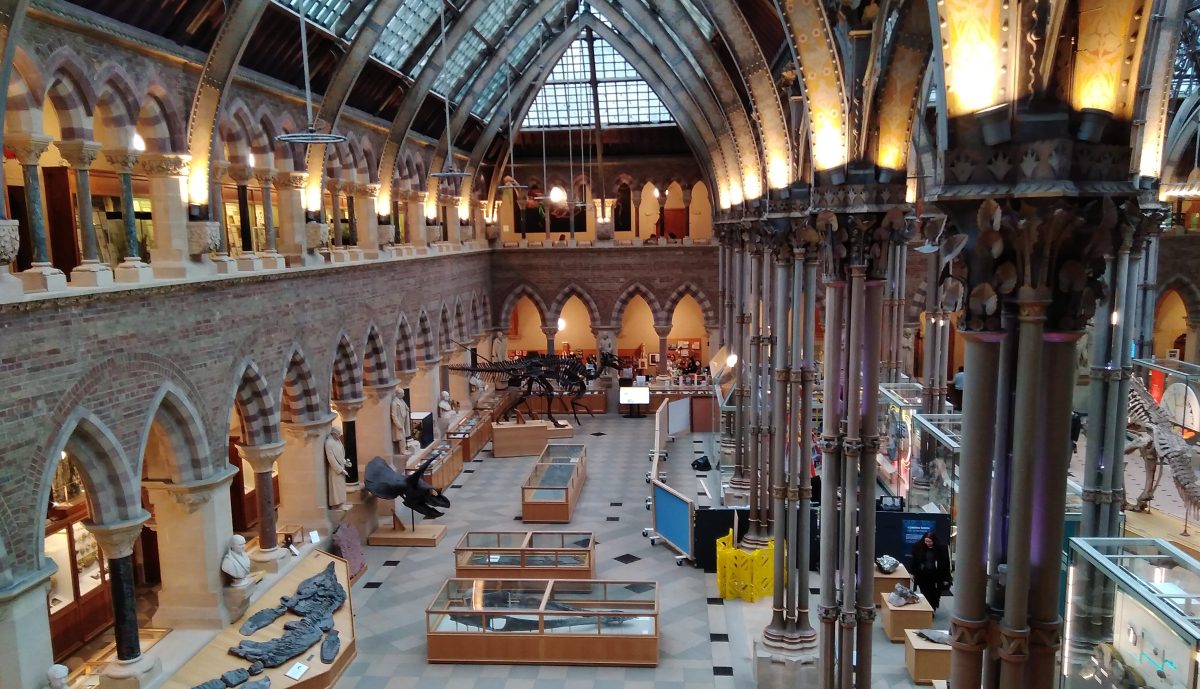
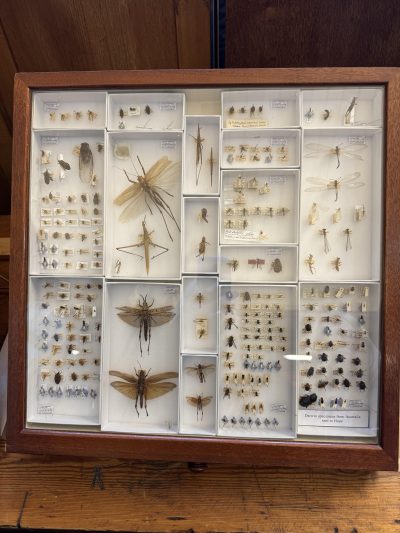
An indoor visit was, perhaps, a good plan when it was 2°c outside! Sixteen of us joined leader Louis Lofthouse for a fascinating tour of the Entomology Department.
There are over 24000 species of insects in the British Isles and, globally, well over a million species have been described to date. The classification of insects can be complex but it is very important to group and identify insects so that they can be studied reliably.
Clearly this was far too much for an afternoon’s visit, so Louis concentrated on showing us examples from four orders, namely Coleoptera, Diptera, Hymenoptera and Lepidoptera, providing interesting information about specific types.
However, before looking at the four orders, we were shown a fine example of a cricket (order: Orthoptera) in answer to a particular request.
Taking the Coleoptera group first, we were shown one of the largest Stag Beetles and compared it with an example of one of the second smallest known micro-beetles. The latter was barely visible to the naked eye, but on inspection using a microscope, its appearance was typical of a shiny backed beetle we would all recognise.
In the Hymenoptera group, Louis talked about parasitic wasps, and in particular how certain wasps lay their eggs on caterpillar eggs, whereupon another wasp lays on those eggs and this happens again.
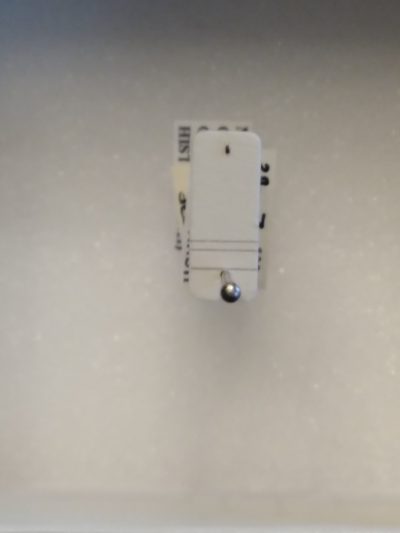
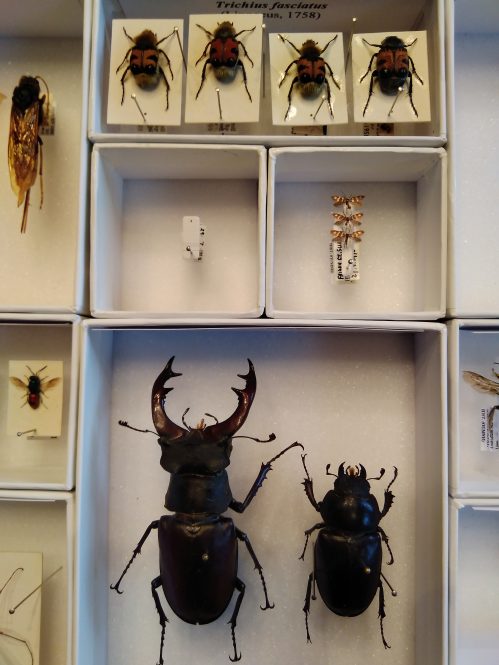
Another example from this order is the fairyfly, a minute insect with slender wings ending in bristles, giving a feathery appearance and which utilises air resistance as if swimming through air. Once again, a look through the microscope enhanced our understanding of this minute specimen.
On to Diptera and Bee Flies. These cuddly looking insects also have antisocial habits, flicking their eggs into the burrows of mining bees. The eggs then develop and hatch within the burrow, feasting on the food provided for the mining bee larvae.
Finally, Louis showed us specimens from Lepidoptera, in particular a fascinating example of a ‘gynandromorphic’ Common Blue in which an aberration caused one side of the body to be male and bluish, while the other side is female (brownish). The wing size can also be different on each side, the male being smaller, giving the butterfly a lop-sided appearance. These specimens would be sterile.
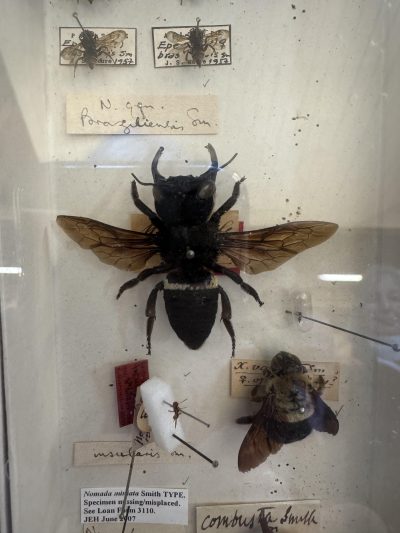
Further examples of global species of insect were available to enjoy on our way up to the Huxley Room, including Alfred Russel Wallis’ Giant Bee, an enormous specimen which would have built its nest in an arboreal termite gallery for protection. This species was thought be extinct until rediscovered in 2018.
We ended our tour in the Huxley Room, scene of the Great Debate of 1860, seven months after the publication of Charles Darwin’s Origin of the Species. Often known as the Huxley-Wilberforce debate, it is best remembered for an exchange in which Huxley was asked whether it was through his grandfather or grandmother that he claimed his descent from an ape. Huxley apparently replied that he would rather have an ape as an ancestor than a man who used his great gifts to introduce ridicule into a grave scientific discussion. A wonderful note on which to end.
Many thanks to Louis for a fascinating and really enjoyable visit.
Stop press:
I spotted a note in the latest BBOWT newsletter about the smallest beetle in Europe, Baranowskiella ehnstromi, which measures just 0.4mm in length. This was found at Rutland Water Nature Reserve, and is only the third British record for this species, the first outside East Anglia. It apparently lives on spores from a bracket fungus. It has to be said, though, that something that tiny must be quite easy to overlook.
Ed
 WEST OXFORDSHIRE FIELD CLUB