6th April 2025
A few weeks ago, many of us enjoyed Neil Clennell’s knowledgeable and entertaining presentation on British reptiles at our AGM. One fine Sunday evening in early April, Neil offered us a second helping of his quickfire expertise on another of his wildlife enthusiasms, this time amphibians.
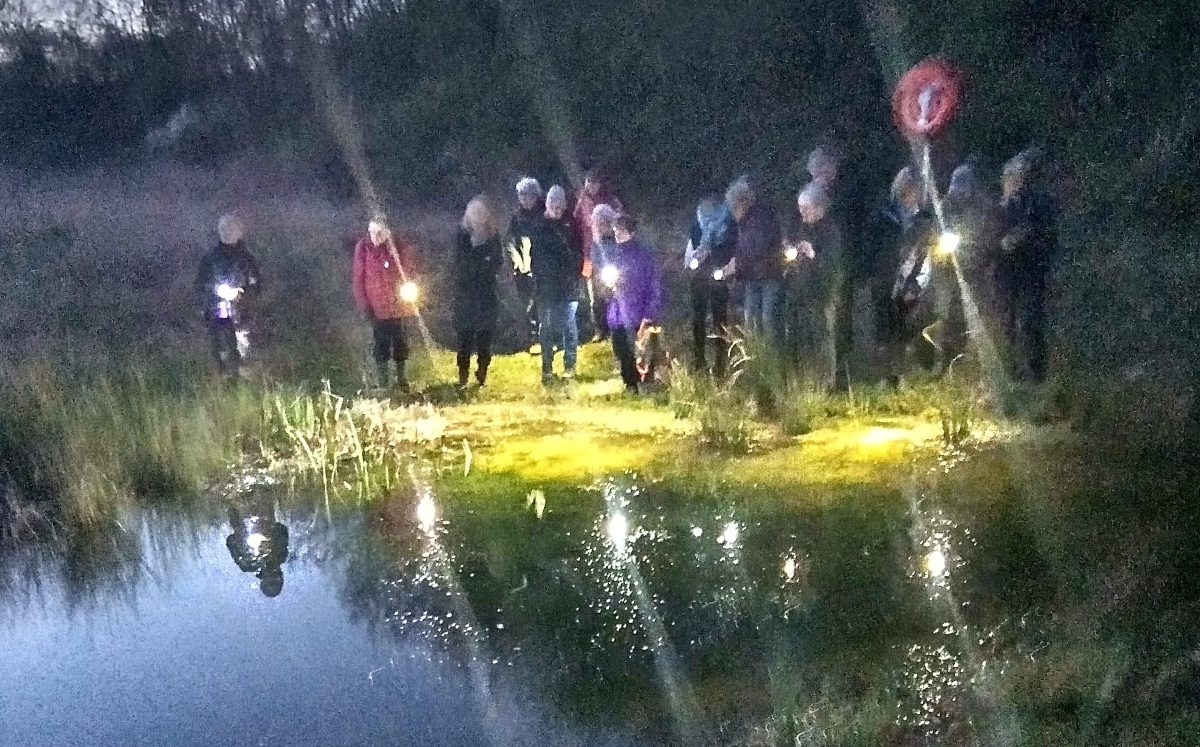
Neil (CEO of the Wychwood Forest Trust), is a leading expert on both these unsung branches of the animal kingdom, and on conservation management in general. As daylight waned, a group of us armed with torches made our way down a quiet rutted track to a field near Chadlington. Dean Pit is a former sand and gravel extraction site, latterly used for landfill but more recently restored for community access by Oxfordshire County Council and now managed by the Wychwood Forest Trust. It consists of a tapestry of light woodland, scrub and sand- or limestone-grassland, interspersed by a multitude of seasonal ponds. This mixed habitat suits our native amphibians well, providing unpolluted water for spring breeding and plenty of cover for foraging later in the year, with less likelihood of turning into a fish supper as tends to happen in permanent lakes or ponds.
Neil gave us an introductory talk on the history and ecology of the site and described our three UK newt species: the small common or smooth newt, the larger palmate one and our main quarry of the evening, Triturus cristatus, the great crested newt. We then set off for the nearest couple of ponds just minutes away. One was already dry after several weeks of unusually rain-free weather, but the other formed a perfect crystal mirror in the windless conditions, reflecting a rising half-moon and a bat flitting overhead.
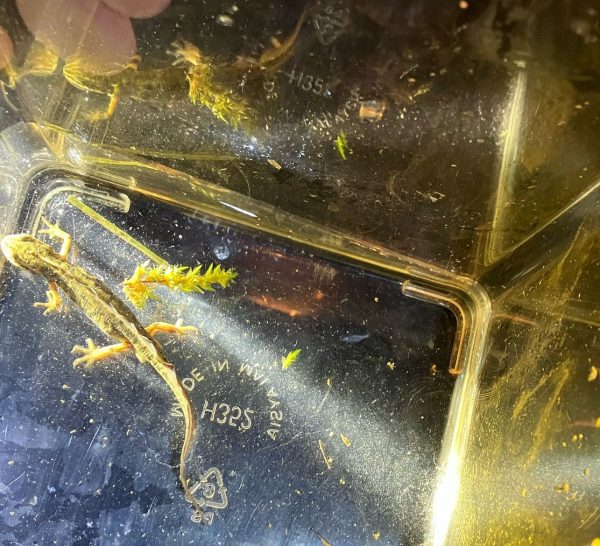
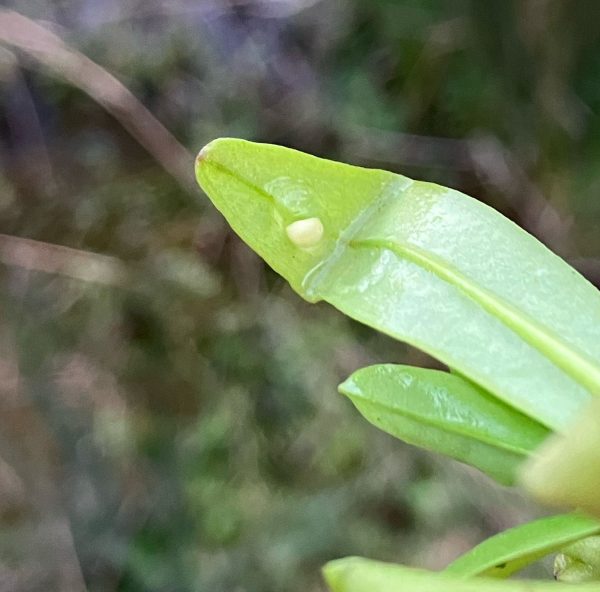
Great crested newts are a protected species, of course, so handling or disturbing them is illegal, and unwise as they secrete neurotoxins in their skins to deter predators. But they can be temporarily captured for counting and scientific examination with a permit, using inverted water bottles as traps with the tops cut off and pushed inside. Neil’s weapon of choice was a rockpool net, wielded gently through the waterweeds, causing minimal disturbance to the pond-dwellers beneath. We saw several small froglets and smooth newts, and a cloud of Daphnia waterfleas dancing mesmerically at the water’s edge. Only Neil in his knee-high wellies and a few others were lucky enough to catch sight of the much larger great crested variety in their smart orange vests (the males develop the crests in the breeding season). But their presence was confirmed by the neatly folded leaf-tips of nearby waterplants, each concealing a single tiny pearl-like egg, ready to produce the next generation.
Great crested newts were once widespread throughout Europe and even into Asia, but have all but disappeared in many places due to habitat loss and pollution. It is heartening to learn that Oxfordshire, despite its rampant building and development projects, remains one of the world’s leading hotspots for these harmless miniature relics from the age of the dinosaurs. Long may they thrive!
Lindsay Fisher
 WEST OXFORDSHIRE FIELD CLUB