
20 June, 2026
As Field Club walks go, this really was a cracker! We were so fortunate in having a warm but not too hot a day, particularly as the following
day reached 28 degrees. In addition, we had a really great leader in the form of Craig Blackwell who made our walk both informative and fun.
The walk involved walking through a variety of habitats. Initially, Craig pointed out a meadow, which had been saved from being planted as an
orchard, covered with a mass of wild flowers, notably Agrimony, Marjoram and Oxeye daisies, an illustration of careful land management.

We then walked down the slope to cross the Evenlode, the water brown and lifeless, a terrible reflection of the poor management with which we are familiar. Alongside the river was a totally different habitat, verdant and rich, with a mass of hemlock, smelling, Craig suggested, of a mouse nest! Certainly, it was a musky, unpleasant odour, rather appropriate for such a poisonous plant.
Craig told us about the Midland Hawthorn (Crataegus laevigata)
that was growing beside the path, different from our Common hawthorn (Crataegus monogyna) in that it has two styles as opposed to one in the Common hawthorn, hence the Latin names.
Reaching the road, we walked up the hill towards the Common, stopping to look at a mass of Wild Liquorice, some still in flower, as well as an abundance of other plants such as Rest harrow and Bladder campion. The plant list (click here) says it all!
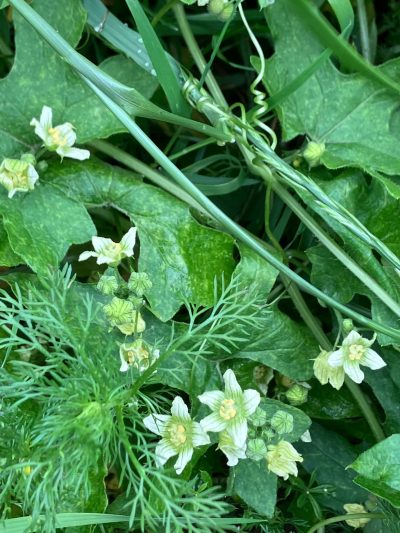
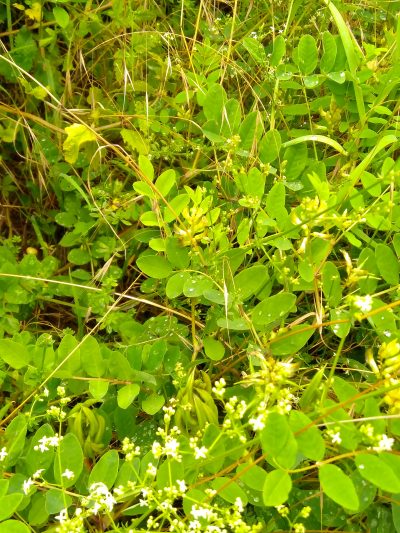
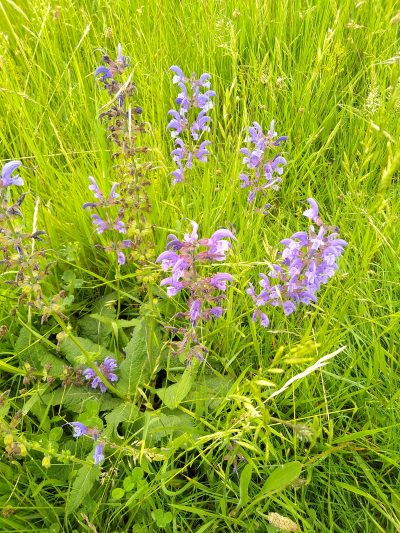
The Common itself, an SSSI and area of unimproved limestone grassland, offered a further variety of plants. Famously this is where Meadow Clary grows, protected and monitored by volunteers.
Very many thanks to Craig for opening our eyes to fascinating facts about the plants which made the walk particularly enjoyable.
Julia Reid

